Holy Week Family Devo 6 - Elementary

jesus-burial.png

Read aloud Mark 15:42-47.

You'll need:
• crepe paper

Take turns wrapping each other in crepe paper just as Jesus may have looked when prepared for burial. Talk about how the disciples might've felt when all their hopes seemed destroyed when Jesus died.

Ask: What do you want to say to Jesus to thank him for dying for you?

Talk about how the burial isn't the end of the story, but that it was a very sad day for Jesus' friends.

Holy Week Family Devo 5 - Elementary

Jesus’ Crucifixion and Resurrection Matthew 26–28
Story Point: Jesus died on the cross and is alive.

Family Discussion Questions:
1. What did Jesus give up in order to save us? Lead kids to discuss not only Jesus’ giving up His life, but His humbling in coming from a position of honor in heaven to earth as a baby. (Read Phil. 2:5-8.)
2. Where is Jesus today? Guide kids to recognize that Jesus is alive! He is in heaven at the right hand of God, and one day He will return to set up His kingdom and make everything right. (Read Heb. 9:28.)
3. What does it look like to “lay down your life” for someone else? Prompt kids to think of situations in which they can put others’ needs before their own. Point out that kids can lay down their lives even while they live, reflecting the servant attitude of Jesus. (Read John 15:13.)

Family Activities: Farther Than the Eye Can See
The Preparation
Materials: Four paper "bases," scrap paper, markers, tape, and a small bouncy ball
Use paper baseball "bases" to form a pretend baseball diamond on the floor. Set out paper and pencils. Wrap a piece of crumpled paper around the bouncy ball and secure it with tape.

Experience: Have family members talk about a time they won something. Gather families around home plate. Have each family member write the word "sin" on a sheet of paper and crumple the paper into a ball.

The Conversation
Say: We talked about winning things. Today we're going to find out that we can't beat problems without God's help. The Bible says everyone has sin and everyone has done wrong things. We can try to throw our sins away to be sinless. Stand at home plate and throw your sin as far as you can into the outfield.
When everyone has had a turn, take the weighted paper ball and throw it as far as possible. Ask: What happened to your sin? Why didn't it go as far as mine did?
Say: My ball went farther away from me because it had extra power.
Read aloud Psalm 103:6-12.
Say: Jesus died on the cross for all our sins. These verses say that God takes our sin far away—farther than we'll ever see or imagine. When we ask for forgiveness, our sin is gone—for good. It's the reason Easter is a time for celebration!

activity sheet 1-2 grade
activity sheet 3-5 grade

Holy Week Family Devo 4 - Elementary

The Last Supper Matthew 26; John 13
Story Point: Jesus ate a special meal with His friends.

Family Discussion Questions:
1. Why do you think Jesus made a new covenant? What happened to the old covenant? Lead kids to recall that God’s people had broken the old covenant, which required complete obedience to the Law. God promised to make a new covenant to forgive sins. God forgives the sins of those who trust in His Son, Jesus. (Read aloud Heb. 8:10.)

2. Why should we serve one another with joy? Help kids identify Jesus as the ultimate servant. In His life and death, Jesus showed how to love and serve one another. (Read aloud Gal. 5:13.)

3. Whom can you serve this week? Encourage kids to choose a friend, family member, or neighbor they can serve this week. Emphasize that God is honored when we love one another. (Read aloud 1 John 4:12.)

Family Activities:
Read aloud Matthew 26:14-16.
You'll need:
• 30 dimes
Tell kids that Judas betrayed Jesus for about 120 days of wages. Let the kids count the dimes and place them at your family worship space.

Ask:
• Was Jesus' life on earth worth more than 30 pieces of silver? Why or why not?
• What was the true value of Jesus' life to our family?

Activity 2
Read aloud John 13:1-5.
You'll need:
• a bowl
• a bar of soap
• paper towels
Jesus washed feet to show his love. Have a bowl, a bar of soap, and paper towels ready. Take turns washing each other's hands and/or feet drying them as you express love to each other.
Display the soap at your family worship space.

activity sheet 1-2 grade
activity sheet 3-5 grade

Holy Week Family Devo 3 - Elementary

Simplified Passover Seder & Family Ice Cream Seder

Preparation
Supplies:
• Bowl of salt water
• Celery sticks (one per child)
• Three matzo crackers
• Paper cups of water for children (half full)
• Small bowl of horseradish
• Small bowl of haroseth
• Hard-boiled egg
• a lamb (or chicken) bone
**Feel free to modify the supplies as needed to what you have at home. We have already very simplified the meal so feel free to modify it more. The point more so is to experience and talk through the below elements of the Passover seder.

Haroseth Recipe
Finely chop two large apples and place them in a bowl. Add 1/3 cup chopped raisins and 2 teaspoons of cinnamon. (Walnuts would normally be used, but substitute raisins to avoid allergy concerns.) Mix.

Pronunciation Guide
• Haroseth (kha-RO-seth)
• Matzo (MAT-se)
• Seder (SA-der)

What is a Seder?
The Passover meal is a powerful experience to give children. It honors God by highlighting his power and love for his people. It connects Bible events for children—and because kids know Jesus for who he is, they can see God's plans from the beginning for Jesus to be our Savior.

Get Started
Arrange a low, round table (or seating on the floor around a tablecloth). Place several candles on the table, and put all supplies on each table, ready for use.
Light the candles and dim the lights before sitting at the table.

Begin Your Seder
Say: Each spring, Jewish people eat a Passover meal called the Seder. It's a reminder that God called Moses to lead their people out of Egypt.
The word Seder means order because everything you eat and drink at a Passover meal is in a special order. We won't serve all the Passover dishes because that takes hours. Instead, we'll try a few and I'll tell you about the rest.

Celery Stick and Salt Water: Ask everyone to take a celery stick. Say: First dip your celery stick in the bowl of water, then take a bite.
Ask: How does it taste?
Say: The salty taste reminds the Jewish people of tears they cried in Egypt while they were slaves.
Ask: Why do you think the Jews in Egypt were sad and cried?

Matzo Crackers: Pass around the matzo crackers. Say: When God gave instructions for the first Passover meal, there wasn't time for the Jews to let their bread rise to get nice and fluffy. So at the Passover, we serve matzo—bread without yeast. We have matzo here. Let's each break off a piece and eat it. Pause to eat matzo and drink water.

Horseradish and Haroseth: Pass around the bowl of horseradish. Say: At a Passover meal the Jews also taste a bitter herb. We won't taste this one—just sniff it. This is horseradish, and not everyone likes the taste.
Say: Bitter herbs remind the Jews of how bitterly they suffered while they were slaves in Egypt. They had very difficult lives.
Say: Here's another food served at Passover: haroseth. Sample the haroseth on a matzo cracker.
Ask:
• What does it smell like?
• What does it look like?
Say: Haroseth looks like mushy cement. The Jews used mushy cement as mortar when they built brick buildings in Egypt. Haroseth reminds them of the hard, hard work they did.

Hard-Boiled Eggs: Set aside the haroseth, and pass the hard-boiled egg.
Ask: Do you dye eggs at Easter?
Say: Eggs are a symbol of springtime and new life. Roasted eggs reminded the Jews that Passover comes in the spring, and of a special festival.

The Lamb (or Chicken) Bone: Pass the lamb bone.
As the bone is passed, say: At the Passover, lamb is served. It's a reminder that spreading lambs' blood on their doorposts kept the Jews safe in Egypt. God saved his people from the plague because he loves them!
Say: The Seder is a reminder of a mighty thing God did for his people. They were slaves and they couldn't escape. Their lives were hard. They cried. They had to make bricks and build huge buildings for Pharaoh. But then God set them free! God brought them to a Promised Land. But he gave them something even more precious than the new land—the promise that a Savior was coming!
John the Baptist confirmed who that Savior was. Read aloud John 1:29.
Jesus Christ is our Passover. Read aloud 1 Corinthians 5:7.
Close in prayer, thanking God for his love.

Family Fun Activity: An Ice Cream Seder
Copy this version of the Seder meal to share with your families.
Supplies:
• Mini marshmallows
• Nuts (If you have kids with nut allergies, substitute unsweetened chocolate chips)
• Brightly colored sprinkles
• Sweet syrup toppings such as chocolate, fudge, butterscotch, or caramel
• Fruit: banana pieces, strawberries, blueberries, or other fruit
• Shredded coconut
• M&M's candies
• Whipped cream
• Vanilla ice cream

Seder Introduction
The Passover meal is all about remembering: remembering God and remembering what God has done for his people.

Ice Cream Seder
Place the listed items (except the ice cream) in separate bowls, and place them on a table.

Gather your family together and say: It's easy to forget what God has done for our family. We're so busy getting ready for school, work, or extra activities that we forget to remember all God does for us. Let's see how these foods can remind us of God's love and how he's touched our family.

Mini Marshmallows: Pass around the bowl of marshmallows. Say: Let's each eat a mini marshmallow. They look like baby marshmallows, don't they? When I remember you as a baby, I always thank God for you. Let me tell you why.
Share a brief story about each child and how he or she has been a blessing to your family.

Bowl of Nuts or Chocolate Chips: Pass around the bowl of nuts and ask each person to taste one. Say: Nuts aren't usually sweet. They often taste bitter, and most nuts come in hard shells. (If using chocolate, say: Chocolate isn't always soft and sweet; sometimes it's hard and bitter.) Let's think about some hard or bitter things that have happened in our family.
Share a brief story of a difficult period for your family and how God helped you through it. Invite others to share their stories.

Bowl of Sprinkles: Pass around the bowl of sprinkles. Say: Pick your favorite color of sprinkle out of the bowl. Sprinkles always look like a fun party to me! What's something fun that's happened in our family—and how did God help that happen?
Let each family member share a story about a fun family time and how God was present during that time.

Syrup: Invite each person to dip a finger in the syrup topping and lick it.
Say: These toppings cover ice cream. God's love covers our family, too.
Share a brief story of a time you felt God's love bringing peace or comfort to your family. Invite other family members to share their stories.

Fruit: Pass around the fruit and invite each person to enjoy a piece. Say: Fruit is a healthy snack to eat. God has helped bring health to our family, too.
Remember and share different times God brought health or healing to someone in your family.

Shredded Coconut: Pass around the bowl of shredded coconut and invite everyone to take a pinch and eat it. Say: Coconut reminds me of snow—and winter. Each winter we celebrate Jesus' birth. I'm grateful God sent his Son, but sometimes I forget to thank God for that gift. What's something you want to thank God for?
Pause while family members respond.

M&M’s: Pass around the bowl of M&M's candies. Ask each person to take his or her favorite color of candy and then look at it. Say: Turn your candy upside down. Now instead of "M&M" it's "W&W"—that reminds me of "Wants & Wishes." God has given our family lots of things we've wanted and wished for, things that go far beyond what we actually need.
Tell a brief story of something you wanted for your family that God provided, and have family members share similar stories.

Whipped Cream: Place a small dollop of whipped cream on family members' index fingers and invite them to lick off the whipped cream. Say: Whipped cream is so sweet—and so is God's love.
Share a story about how God's love has sweetened your life, and let others share their sweet stories as well.
Say: It'd be a shame to have all these toppings and not enjoy them with ice cream!

Give each family member a bowl and spoon, and reveal a container of vanilla ice cream. Invite family members to cover their ice cream with their choice of toppings. Before you eat, offer a prayer of thanks to God for your family, and for God working in and through your family.

Holy Week Family Devo 2 - Elementary

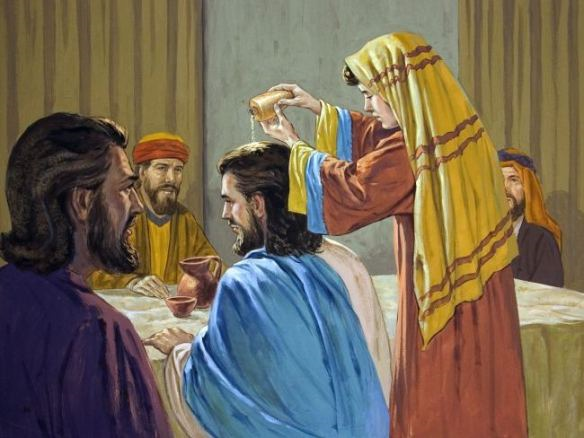
anointing-oil.png

Read aloud Mark 14:3-9.

This woman gave Jesus a gift that was very precious. We can give gifts that come from our heart, too.

Have each family member share something he or she can do to honor Jesus. As each person shares, spray perfume into the air or on the person.

Decorate a beautiful piece of paper and form a cylinder around the perfume bottle for display at your family worship space.

Holy Week Family Devo 1 - Elementary

money-lenders.png

Read aloud Mark 11:15-18.

Tell your children that this area of the Temple was the place non-Jews could come to pray, but it had become a dirty, noisy, unworshipful place.

Together, decorate a worshipful space in your home for Easter Week. Include a Bible, candles, and an area to display the items you'll use this week. A small, bare tree branch laced with white Christmas lights makes a nice backdrop.

You can review these items at the beginning of each devotion. Light the candles or turn on the lights only during devotions to keep it special and meaningful.

Jesus’ Triumphal Entry - Elementary

Matthew 21; Mark 11; Luke 19; John 12
Story Point: People welcomed Jesus as their King.

Family Discussion Questions:
1. Why is it important that Jesus rode into Jerusalem on a donkey?
Lead kids to conclude that Jesus’ fulfillment of the Old Testament prophecies was evidence that Jesus is God’s Son, the promised Messiah. Discuss how Jesus’ entry on a donkey showed His humility. He didn’t enter the city on a warhorse like people might expect a victorious king to do. (Read Matt. 5:17.)

2. Have you learned anything about Jesus that surprises you? Guide kids to identify attributes of Jesus that they did not expect from a king. Help them consider the ways in which the kingdom of God is “upside-down” from kingdoms of the world. (Read John 18:36.)

3. What do you think it will be like when King Jesus returns? Invite kids to share their ideas. (Read Isa. 65:17-19.)

Family Activity:
Read aloud Mark 11:1-11.
Make palm-leaf cookies by following these steps:
1. Cut frozen cookie dough into 2 x 1/2-inch strips.
2. Place aluminum foil on a cookie sheet and spray it with nonstick cooking spray.
3. Roll the cookie strips and shape them into an outline of a palm leaf on the foil. Close all edges in the outline.
4. Crush green candies in a bag with a hammer, and sprinkle to fill in the cookie center.
5. Bake at 375 degrees for about eight minutes.
With your family, contrast the sweetness of the cookies with the harshness of breaking the candies with a hammer. Tell your children that this was a sweet day for Jesus, but he knew that soon he would be broken—or would die—for our sins.

Join us every afternoon at 4pm this week on Facebook! We will be posting a family devotional and activity every day for you to bring Jesus' last week to life in your home.

ACtivity sheet 1-2 grade
Activity sheet 3-5 grade

We Try Not to React to Strange Items - Elementary

This Sunday we are looking at how to control our emotions. Emotions are good indicator of what's happening in us, but not a good guide for us. Grab your family and dive into learning together how to control your emotions! After watching the video follow the script below 😃

Key Verse- Philippians 4:8 NIV Finally, brothers and sisters, whatever is true, whatever is noble, whatever is right, whatever is pure, whatever is lovely, whatever is admirable—if anything is excellent or praiseworthy—think about such things.

Parent/Child Discussion 1. What stood out to you the most from the message?

What’s one thing you learned?

2. Think back to our Color Quiz game. Why is it easier to get things right when we think and respond instead of when we blindly and immediately react to situations? Ideas: Thinking for a moment gives you a chance to stop yourself from jumping into wrong choices based on sudden emotions.

3. Read Philippians 4:8 NIV. What does this verse teach us about responding instead of reacting to situations? Idea: It teaches us to focus on whatever good there may be, instead of jumping to the negative.

4. Which emotion is hardest for you to control?

5. How can you take control when your difficult-to-control emotions are surfacing? Ideas: Talk to a trusted adult, take a deep breath, count to 10, get some exercise, pray, sing songs to God, play peaceful music, etc.

Pray together. Pray that your family would train their mind to obey and follow Jesus. Pray that they would begin to see more that is true, noble, right, pure, lovely, admirable, excellent, and praiseworthy.

Family Activity- Color Quiz A fun way to show how reacting isn’t as effective as responding. Objective: Draw the right color stick—without looking. Materials: Green, Yellow, Blue, and Red craft sticks Instructions:

1. Have two family members sit facing one another.

2. Give them one of each color of craft stick: one green, yellow, blue, and red.

3. Say: Let’s pretend each craft stick represents an emotion. Like this: • Green = Peaceful • Yellow = Happy • Blue = Sad • Red = Angry • Have them place the craft sticks in front of them.

4. Say a color and emotion. Then, quickly say, “1, 2, 3, show me!”

5. Both people hold up the colored stick that matches the color and emotion you said.

6. Say: Yeah, so, of course, you both got it right! See how easy it is when you respond by looking for what you need to show? But, wait. You didn’t think our game was gonna be that easy, did you? Let’s see how easy it is when we choose to react without thinking and looking at the situation first.

7. This time, family members hold the craft sticks behind their backs.

8. Say a color and emotion, quickly count to three, and have family members try to pull out the matching craft stick without looking.

9. If they matched, celebrate with wild applause!

10. If not, reset and immediately try again.

11. After a few rounds, see if anyone else wants to try the color quiz, and repeat steps 9-12.

YouVersion Bible Reading Plan That Goes with Series- Think About the Things You Think About

Mind Control - Elementary

Kids Church Online Begins Today... We are jumping into a series today called Mind Control. We are going to be looking at how we control our attitudes. Use the outline below as a family after you watch this week's episode!

Key Verse- Philippians 4:8 NIV Finally, brothers and sisters, whatever is true, whatever is noble, whatever is right, whatever is pure, whatever is lovely, whatever is admirable—if anything is excellent or praiseworthy—think about such things.

Parent/Child Discussion

1. What stood out to you the most from the message? What’s one thing you learned?

2. Have you ever been in a bad mood? What’s the type of thing that usually puts you in a bad mood?

3. Why do you think it’s hard for people to control their thoughts? What would make it easier?

4. When is it hard to have a positive attitude?

5. Read Philippians 4:8 NIV. How can this verse help you when you get in a bad mood?

6. Think about a time when you were thinking thoughts that were angry, jealous, complaining, overly sarcastic, self-pitying, and the like. How did you stop those thoughts? How can you do better at stopping them faster the next time they try to take over your mind?

Examples: Don’t spend time focusing on negative or sinful thoughts; focus on things you’re grateful for; write down some things you can praise God for even in the middle of a tough situation; etc. Pray together. Pray that your family would be able to use their minds to focus on what God wants them to think about. Pray that they would begin to have the mind of Christ, not a mind of complaining, anger, fear, or other sinful or negative thoughts.

Family Activity- Keep it Up! A fun and frantic game to show that sometimes it takes some work to keep your thoughts in the right place. Object: Keep balloon from hitting the ground. Supplies needed: balloon, dice

1. Say: Sometimes, life’s great, and everything seems to be just floating along—when WHAM! Something you weren’t expecting can cause your emotions to drop to the ground. Let’s play a game about that—using a balloon to represent our emotions!

2. Have your family stands in a circle.

3. Give your family the balloon and tell them to keep it from touching the ground. NO ONE can hold it. They must keep volleying it so it doesn’t touch the ground.

4. Explain: I’m going to roll this die about every three seconds. If I roll an EVEN number, you can keep bouncing the balloon in the air. If I roll an ODD number, you have to put your hands to your sides—no touching the balloon—for three seconds!

5. Family members bounce balloon while you roll the die.

6. If you roll an even number, tell family members to continue, count to three, and roll again.

7. If you roll an odd number, tell family members to STOP, count to three, and roll again. If it’s an even number, family members resume volleying. If it’s odd again, the balloon will probably hit the ground by the time you count to three and roll again!

8. Repeat steps 5-7 as long as the balloon stays in the air.

9. If the balloon touches the ground, start over, repeating steps 5-7 as long as possible.

YouVersion Bible Reading Plan That Goes with Series - Think About the Things You Think About

activity download